
Recently I won an online auction for an older Canon EOS camera body, but at first I was more interested in what was included with it – a Canon 1EG gadget bag, highly prized by professional photographers in the 1990s and the perfect addition to my growing camera collection. When I received the bag and looked inside, I was surprised to find the camera was an EOS 620, one of the very first models Canon introduced in 1987. Curious about whether it worked, I popped in a fresh battery, attached a lens, turned it on… and was pleasantly surprised to see it come to life. A few quick tests showed everything appearing to work just like it did 39 years ago when it first came on the market.
Canon introduced the EOS system in 1987, and the 620 was one of the first models in the line — positioned for working professionals where its sibling, the EOS 650, was aimed at amateurs. One of the key advantages of the EOS design was the EF lens mount, which meant that lenses made for the 620 in 1987 work just as well on Canon DSLRs made decades later — including the ones I shoot today.
With the finding that this “bonus” 620 worked, and having a rekindled interest in film photography (a topic for other posts), I decided to give the camera a try. It was much an experiment about myself as it was the camera. Having been used to DSLRs for many years, returning to film has been a challenge… but a welcome one. This would be different in several ways. First, the 620 is much smaller and lighter than my DSLRs with their bulky battery grips. Second, I chose an “era appropriate” lens to shoot with, having no modern optics to improve image quality and no image stabilization (IS) to help with camera shake. Even the subject I chose was a challenge – a municipal cemetery located a couple of miles from my home.
One thing I had in my favor was a long memory of film shooting, which I’ve mostly carried over into the digital age. I’ve always taken the measured and forcefully thoughtful approach to my shots, trusting my instincts and timing and generally bringing home far fewer images to be edited than many digital photographers.
Initially I drove through the cemetery looking for interesting monuments and scenes. As one of the city’s oldest cemeteries, if not the oldest, there was much to cover. Working outward from the chapel located near the center of the property, I moved among the many rows and sections of graves. There are veterans from the late 1800s through today, along with other prominent locals including members of the Munson family (T.V. Munson, a viticulturist, was instrumental in saving the French wine industry by developing a grafting process that bonded grape vines with disease-resistant rootstocks).
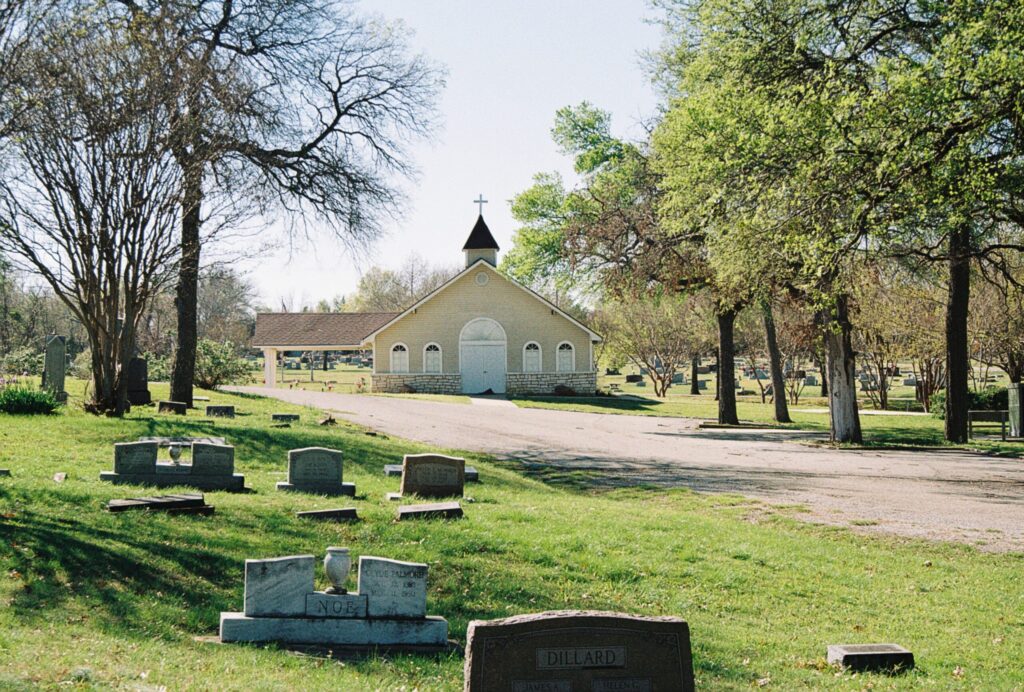


But most of the graves here are of the everyday – husbands and wives, mothers and fathers, sons and daughters. A bronze sculpture of a boy releasing a bird into flight, simple markers left by a family to remember beloved parents, fraternal memorials, and deeply religious ones… there was no end to the variety, exactly what I needed to show me what the old camera could do.


I found handling the 620 to be a bit challenging at first. Without the extended length of a battery grip I had to adjust how I held it, especially when I rotated the camera 90 degrees for a portrait shot and there was no vertical shutter button. The older lens wasn’t as forgiving either, particularly when close focusing, which forced me to step back slightly from some subjects. At first I used an old trick of turning on focus confirmation (we used to call it “focus beep” as it sounds a soft beeping tone when the autofocus locks), but about halfway through the roll it had become almost second nature.
By the end of the shoot I was very comfortable handling the camera and working with the old lens. The images that came back showed that despite its age the “Oldest EOS” still held up well.
Will I use the EOS 620 regularly? Probably not, as I have an EOS-3 for my primary film body. But would I use it again if the opportunity came up? Absolutely.
Technical Summary
- Camera: Canon EOS 620
- Lens: EF 35-135mm f/4-5.6 USM
- Film: Kodak Kodacolor 200, 36-exposure roll
- Location: Fairview Cemetery, Denison TX
- Date: 3/21/2026
- Time: Mid-afternoon, approx. 2:30pm
- Weather: Clear skies, low 80s
[All images taken by me and subject to copyright. Credit to Process One in Overland Park, KS for film processing and scanning,]